I've been mulling on something since June 2011, when I attended my first Unitarian Universalist General Assembly (UU GA).
As I've previously mentioned, I spent that GA in a scooter. It was an eye-opening experience - not being seen by the crowds in the halls while my head was basically at waist level, not being able to see the projected words for unfamiliar hymns during worship, having to wait in line for the elevator instead of running up stairs, and waiting for people to come along and open doors when I couldn't find the button to do it myself.
I've been mulling on how to articulate what it was like to people who've never sat in a wheelchair or scooter. How do you explain such a life changing experience, to a fully-abled person who has never been there? After over a year, it dawned on me whole driving home from church this past Sunday.
I live in Texas - the land of pick-up trucks and SUVs. I drive a compact car - a Toyota Yaris. Being in a scooter or wheelchair is like driving a Yaris in Texas. Now, this might not immediately make sense to you, so let me explain my metaphor.
Imagine you are driving along the Texas highway, in a 2007 manual transmission Toyota Yaris. When you sit down in your car, it's a little lower to the ground than your standard dining chair height.
- Toyota Yaris by Carolyn C

You are on open highway - you can cruise along at the speed limit with absolutely no problems. The few times you encounter anyone else on the road, you simply change lanes and pass them by. The folks in the vehicles you pass, both small and large, wave at you. It's Texas after all, and we try to be friendly. :)
Then, bam! - you hit rush hour traffic. It's Texas, so your little car is surrounded by pick-up trucks and SUVs. You can't see over them, so you don't know how long the traffic jam is going to be. You can't see around them, so you don't know if you can get over and make it to the exit lane. You resign yourself to sitting in traffic and being late to wherever you're going. That's when you start having problems.
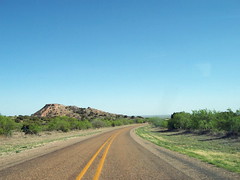
Texas Highway by CoreBurn
This is Texas - the pick-up trucks and SUVs think they own the road. They're the ones with the huge cattle guards on the front of their vehicles, and they assume everyone who's not in the same category should get out of their way. They don't check their blind spots - they're bigger, therefore you should automatically see them, right? They have Hemis' under the hood, so it's fine with them if they cut you off, because God forbid they're behind your small car that might take a little longer to get up to speed. They have the brand-new, straight from the factory brakes that can stop on a dime - what do you mean your little Yaris might take a while to fully stop because it's older, needs a brake job and you need time to shift?
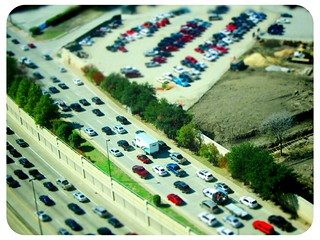
Dallas traffic by nffcnnr
The lane to the right of you starts moving quickly. So you put on your turn signal, and start looking for an opening. Truck after truck, SUV after SUV - they whiz by you, completely ignoring you. Finally, another small car comes along and lets you in. You finally can get to where you were going.
That's what it's like being in a scooter or wheelchair when you're in the middle of a crowd. Surrounded by people standing all around you, walking while you're sitting there, unable to navigate. Having people suddenly stop in front of you, and you are just praying that the scooter will stop before you hit them. Unable to dart around the groups of people that cause traffic jams in hallways, you patiently (or more often than not, impatiently) wait until traffic clears enough to get around them. It's driving a Yaris in Texas, wishing the traffic jam would clear up.
_________________________________________________________________________________
At large gatherings, and sometimes at smaller ones, people are often told "We're a community that included everyone, regardless of ability. People in wheelchairs and scooters are not invisible - look down every once in a while." Often, these exhortations mean little until they directly effect the fully-abled. Once they or a loved one learn what it is like to be ignored, to feel invisible in the middle of a crowd - then, suddenly they're looking down, recognizing barriers and helping to remove them.
General Assembly is the largest single gathering of Unitarian Universalists every year. We learn from our mistakes and challenges every year, and make improvements. In 2012, we had mini-hymn books we gave to everyone in scooters or wheelchairs so that when everyone else stood, those of us unable to stand still could sing the hymns.
Yet, I wonder - are we making progress in our home congregations? Are our congregations like the open highway where everyone can move around and we all wave at each other? Or are our congregations like rush hour traffic? I know my congregation is a bit of both at times - we've been working on becoming more like the open road than we were before.
Here are some great links that you might find useful if you're wondering if your congregation is a traffic jam or an open highway:
- EqUUal Access's Accessibility Guidelines for UU Congregations (opens in MS Word)
- UUA's Accessibility Manual - .pdf file
The UUA's accessibility manual includes a relatively easy and almost free audit that a small group in the congregation can do to assess how accessible the congregation is. Best part? It doesn't audit for only mobility impairments - but an entire gamut of things that you might not even realize are problems unless you know someone with invisible disabilities.
