Showing posts with label UU. Show all posts

Thursday, July 5, 2012

The view from Down Here

I've been mulling on something since June 2011, when I attended my first Unitarian Universalist General Assembly (UU GA).  

As I've previously mentioned, I spent that GA in a scooter.  It was an eye-opening experience - not being seen by the crowds in the halls while my head was basically at waist level, not being able to see the projected words for unfamiliar hymns during worship, having to wait in line for the elevator instead of running up stairs, and waiting for people to come along and open doors when I couldn't find the button to do it myself.

I've been mulling on how to articulate what it was like to people who've never sat in a wheelchair or scooter.  How do you explain such a life changing experience, to a fully-abled person who has never been there?  After over a year, it dawned on me whole driving home from church this past Sunday.

I live in Texas - the land of pick-up trucks and SUVs. I drive a compact car - a Toyota Yaris. Being in a scooter or wheelchair is like driving a Yaris in Texas. Now, this might not immediately make sense to you, so let me explain my metaphor.
 Imagine you are driving along the Texas highway, in a 2007 manual transmission Toyota Yaris.  When you sit down in your car, it's a little lower to the ground than your standard dining chair height.
Toyota Yaris - not a big car!
Toyota Yaris by Carolyn C
You are on open highway - you can cruise along at the speed limit with absolutely no problems. The few times you encounter anyone else on the road, you simply change lanes and pass them by. The folks in the vehicles you pass, both small and large, wave at you. It's Texas after all, and we try to be friendly. :)

Texas Highway by CoreBurn
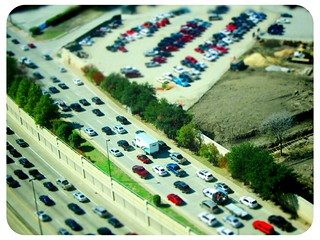
Then, bam! - you hit rush hour traffic.  It's Texas, so your little car is surrounded by pick-up trucks and SUVs.  You can't see over them, so you don't know how long the traffic jam is going to be.  You can't see around them, so you don't know if you can get over and make it to the exit lane.  You resign yourself to sitting in traffic and being late to wherever you're going.  That's when you start having problems.
Dallas traffic by nffcnnr
This is Texas - the pick-up trucks and SUVs think they own the road.  They're the ones with the huge cattle guards on the front of their vehicles, and they assume everyone who's not in the same category should get out of their way.  They don't check their blind spots - they're bigger, therefore you should automatically see them, right?  They have Hemis' under the hood, so it's fine with them if they cut you off, because God forbid they're behind your small car that might take a little longer to get up to speed.  They have the brand-new, straight from the factory brakes that can stop on a dime - what do you mean your little Yaris might take a while to fully stop because it's older, needs a brake job and you need time to shift?
The lane to the right of you starts moving quickly.  So you put on your turn signal, and start looking for an opening.  Truck after truck, SUV after SUV - they whiz by you, completely ignoring you.  Finally, another small car comes along and lets you in.  You finally can get to where you were going.

That's what it's like being in a scooter or wheelchair when you're in the middle of a crowd.  Surrounded by people standing all around you, walking while you're sitting there, unable to navigate.  Having people suddenly stop in front of you, and you are just praying that the scooter will stop before you hit them.  Unable to dart around the groups of people that cause traffic jams in hallways, you patiently (or more often than not, impatiently) wait until traffic clears enough to get around them.  It's driving a Yaris in Texas, wishing the traffic jam would clear up.

_________________________________________________________________________________


At large gatherings, and sometimes at smaller ones, people are often told "We're a community that included everyone, regardless of ability.  People in wheelchairs and scooters are not invisible - look down every once in a while."  Often, these exhortations mean little until they directly effect the fully-abled.  Once they or a loved one learn what it is like to be ignored, to feel invisible in the middle of a crowd - then, suddenly they're looking down, recognizing barriers and helping to remove them.

General Assembly is the largest single gathering of Unitarian Universalists every year.  We learn from our mistakes and challenges every year, and make improvements.  In 2012, we had mini-hymn books we gave to everyone in scooters or wheelchairs so that when everyone else stood, those of us unable to stand still could sing the hymns.  

Yet, I wonder - are we making progress in our home congregations?  Are our congregations like the open highway where everyone can move around and we all wave at each other?  Or are our congregations like rush hour traffic?  I know my congregation is a bit of both at times - we've been working on becoming more like the open road than we were before.

Here are some great links that you might find useful if you're wondering if your congregation is a traffic jam or an open highway:

The UUA's accessibility manual includes a relatively easy and almost free audit that a small group in the congregation can do to assess how accessible the congregation is.  Best part?  It doesn't audit for only mobility impairments - but an entire gamut of things that you might not even realize are problems unless you know someone with invisible disabilities.

Tuesday, June 26, 2012

Youngling Programming

My son, age 13, really, really wanted to come to General Assembly (GA) in Phoenix this year.  He wanted to be there to work for social justice, after years of listening to emma's revolution CDs in the car with me. 

We were initially very reticent to allow him to come with us.  Last year in Charlotte, we'd seen very few younglings (which is what I call tweens & teens) - either they were babies and toddlers, or they were old enough to participate in Youth Caucus (which starts at 14).   There was not childcare available at GA unless you had a hotel that could refer you to babysitting services in the area - and anyone with kids can attest to how ridiculously expensive that would be for an entire week.

Yes, General Assembly is primarily about the business of the Unitarian Universalist Association (UUA), and congregational polity.  However, it's also about creating community for a week, networking with others on issues that matter, and having the opportunity to learn from others.  Those last three are all things that younglings of all ages can benefit from.

Apparently, someone on the GA Planning Committee (or someone who had their ear), realized that entire families would be coming to Phoenix - that the younglings raised as Unitarian Universalists (UUs) would be bugging parents to be able to participate in this historic social justice oriented GA.  We were surprised and grateful to see during online registration that there would not only be a place for younglings at GA, but that there would be age-appropriate programming for them.

Our son participated in "Justice Camp" - programming that was designed for younglings ages 10 to 14.  You can read more about Justice Camp and see pictures by clicking here. Justice Camp was critical in providing our son with a positive experience at his very first General Assembly.  He learned about issues relating to the environment, class, immigration, and the Doctrine of Discovery.  He learned about the vocabulary of justice work.  He helped with the "Beat the Heat" backpack project and did a water scavenger hunt. He played games, made new friends, and even got to go swimming. 

Now, to be fair and give my youngling's voice a chance to be heard, he would have liked more swimming and a little less learning.  He was bored by lecture parts of programming (generally true of him & lectures all the time), but he really enjoyed the field trips and got a lot out of the hand-on learning opportunities they had.  He was so animated when he talked about the presentation by the Phoenix Dreamers, a group working on educating others and calling for passage of the DREAM Act.  And he is really psyched that he has friends in Houston, San Francisco, and a bunch of other places across the country.


I readily admit that I don't know a single youngling under the age of 15 who cares about congregational polity, my own included.  However, I do know younglings through my work as a youth advisor that do care about the business of the UUA, about the Congregational Study/Action Issues, about the Responsive Resolutions that get brought before delegates at GA.  I don't know if next year's GA planning currently includes anything like Justice Camp, but I really hope that it will because: 
  • It allows families to make the trip to GA together
  • It allows our younglings to begin developing deep relationships before they even get to Youth Caucus
  • It's an opportunity to have a hands-on component to learning about our faith that doesn't necessarily always happen in our congregations
  • GA becomes intentionally multi-generational - if we want that in our congregations, why wouldn't we expect our GAs to be uplifting that as an ideal to aspire to?
  • It exposes our younglings to the idea that even at the national level, we all have a voice and we live our Fifth Principle 
  • Attendance of younglings at GA is an opportunity unlike any other to expose them to the idea of congregational polity not only being about congregations being self-governing, but that it's important to have relationships with each other
  • GA is an opportunity to experience worship in a completely different setting and context than our congregations
My son will be in Youth Caucus next year if he attends GA in Louisville, Kentucky - but there is so a need for this type of programming for younglings who come to GA in the future, and I really hope that it will be there for them.

Home from General Assembly

I just returned home from Phoenix, Arizona, where my family (along with thousands of others) attended the 2012 General Assembly (GA) of the Unitarian Universalist Association (UUA).  It was a historic GA, our very first Justice GA.  We came as people of faith, from all across the United States, to stand in solidarity with those fighting for immigration reform and against the dehumanizing policies and laws enacted in our country like SB1070.

For my first several posts to this blog, I'll be reviewing what the experience was like, and reflecting upon what I brought home from Arizona.


More than anything else, I have brought home an overwhelming sense of gratitude and privilege.

I was blessed to attend this General Assembly.  I was blessed to be able to bring my entire family, and a youth from our congregation.  We did not have the economic ability to fund this trip, and I was blessed by being able to be a volunteer at GA to cover my registration costs.  The youth that came with us was blessed by receiving a scholarship that allowed for her attendance.  I was blessed with there being programming specifically designed to allow younglings aged 10 to 14 an opportunity to learn, engage in social justice and make connections.

I was privileged to hear the stories of families who are being torn apart by our current immigration system and it's policies.  I was privileged to hear the story of a family who's loved one is in Tent City jail, a man who was unable to be there when his now 3 month old child was born.  I was privileged to bear witness to the dehumanization of migrants and to be there in solidarity with them.  I was privileged to work with the Accessibility Team at GA, and to help make GA a good experience for so many folks who face marginalization so regularly.  I was privileged to be on-site at the candle-light vigil to ensure that those folks with mobility limitations were able to fully participate in it.  I was privileged to get to meet so many from all around the country and hear their stories.  I was privileged to make connections.

I attended GA in Charlotte, North Carolina last June.  It was educational and helped to transform the way that I approach leadership.  I had a completely different perspective regarding accessibility after spending the week in a scooter.

This year, I returned home renewed and transformed.  Working accessibility was more deeply moving and meaningful that I ever thought it would be.  The hallway conversations that I had helped transform the way I view being considered a young adult (YA) and how I can transform our congregation and faith.

May I continue to be transformed by the stories of others, feel privileged to be told them, to be humbled by them, and reminded of the blessings that have been bestowed upon me by others and God.